DesktopLinux
Home  |  News  |  Articles  |  Forum  |  Polls  |  Blogs  |  Videos  |  Resource Library

Keywords: Match:
Major Mono rev ships
Oct. 06, 2008

Novell announced the availability of its dual-licensed cross-platform implementation of Microsoft's .NET development framework. Some five years in the making, Mono 2.0 adds "full" compatibility with .NET 2.0, improves performance and stability, and introduces an analytical tool for .NET-to-Linux migrations, says the Mono project.

(Click for larger view of F-Spot, a Mono-based photo manager for GNOME Linux desktops)

Mono is a from-scratch implementation of Microsoft's .NET runtime and application development framework. Novell acquired the technology with its 2003 purchase of Ximian, a start-up co-founded by Mono project instigator Miguel de Icaza.

Mono 2.0 arrives some five years after the release of Mono 1.0, which shipped in early 2004. Significant interim releases include Mono 1.2, which added cross-platform features, and Mono 1.2.3, the first release with a Visual Basic.Net compiler actually written in .NET.

During the last couple of years, Mono has become an increasingly important part of the Linux desktop, underpinning such ubiquitous packages as the f-spot photo manager, Banshee music player, and Beagle desktop search utility. It has also seen use in countless commercial software projects, and even in web applications such as those powering social networking site iMeem.


Second Life
(Click to enlarge)


One of the best known Mono-based deployments is the Second Life online virtual worlds project (pictured). The site's developer, Linden Lab, uses Mono to "improve the stability and speed of scripts -- particularly calculation-intensive ones," says the Mono group. A sampling of Mono applications can be found here.

Mono 2.0

Mono 2.0 now supports Linux, Solaris, Unix, Mac OS X, and BSD, says the group. The Mono 2.0 compiler is said to be fully compatible with Microsoft .NET 2.0, and also mimics portions of later versions. The Mono API "today is somewhere in between .NET 2.0 and .NET 3.5," says the Mono FAQ.
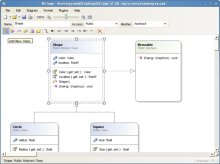

Two Linux-compatible Mono apps: NClass UML modeling app (left)
and Codice Plastic SCM (Source Control Management) system (right)

(Click on either to enlarge)

Major Mono components are said to include:
  • Common Language Infrastructure (CLI) virtual machine that contains a class loader, just-in-time compiler, and a garbage-collecting runtime

  • Class library compatible with any language that works on the CLR, with both .NET compatible class libraries and Mono-provided class libraries

  • C# compiler (now rev'd to C# 3.0 support)
A key new version 2.0 feature for Linux developers is the Mono Migration Analyzer (MoMA), which "helps developers quantify the number of changes required to run their .NET application in a Linux environment," says the group. Running natively on .NET or on the Mono framework, MoMa helps pinpoint platform specific calls (P/Invoke) and other areas "that are not yet supported by the Mono project," says the group. It also is said to report locations where native code is invoked, but which may not be portable. Based on an analysis of 4,600 .NET applications using MoMA, 45 percent required no code changes to work with Mono, and an additional 24 percent required fewer than six code changes, claims the group.

Additional new features in Mono 2.0 are said to include:
  • Easier installation -- one-click installation for SUSE Linux Enterprise and openSUSE

  • More comprehensive platform and hardware support -- specific hardware support includes x86, AMD 64, IA-64 (Itanium 2), EMT 64, PowerPC, ARM, S390 and S390x, SPARC, and SPARC 9

  • Improved .NET API support -- supports all Microsoft .NET 2.0 APIs, including ASP.NET, ADO.NET, and Windows.Forms

  • C# 3.0 LINQ support -- C# 3.0 compiler with LINQ support

  • Performance upgrades -- Better scaling and performance claimed for ASP.NET. ADO.NET, and Mono runtime

  • New Virtual Machine image -- downloadable image with a "ready-to-use development environment"

  • New downloads -- open source web and desktop .NET applications included, such as ASP.NET Starter Kits
Aside from MoMa, other new or greatly improved tools available in Mono 2.0 are said to include:
  • Debugger -- a debugger for managed code
  • Gendarme -- an extensible rule-based tool for locating problems in .NET applications and libraries that are not typically checked by compiler
  • Mono Linker -- XML-based linker for reducing size of executables and libraries
  • Mono Tuner -- a tool for applying arbitrary user-defined transformations to assemblies
  • Mono Documentation -- toolset upgraded to support documenting generics and extension methods
In July, the Mono group released version 0.7 of a new offshoot of Mono called Moonlight. This Mono-based Moonlight plug-in emulates Microsoft Silverlight, a cross-platform multimedia plugin built on top of the VC-1 video format. Moonlight is being incorporated into Nokia's Maemo distribution used on its Linux-based Nokia Internet Tablets.

Stated Jim Purbrick, technical director, Core Platform, Linden Lab, "Deploying Mono as the primary scripting engine on the Second Life Grid has had enormously positive effects for our Residents. In fact, some of the internal benchmarking we've done has shown that scripts running on Mono run up to 220 times faster."

Availability

Mono 2.0 is available now for free download, says the Mono project. The download page should be here, and general information may be found here. Users statically linking the Mono runtime -- for example, for use in iPhone applications -- will need a commercial license, according to the project.

-- Eric Brown. Henry Kingman also contributed to this report.


Do you have comments on this story?


Talkback here

NOTE: Please post your comments regarding our articles using the above link. Be sure to use this article's title as the "Subject" in your posts. Before you create a new thread, please check to see if a discussion thread is already running on the article you plan to comment on. Thanks!


Related Stories:


(Click here for further information)


Approaching the Linux Desktop
The purpose of this paper is to help organizations evaluate the Linux desktop against their own enterprise needs and discover what benefits the Linux desktop might bring to their organizations.

Migrating To Linux: Application Challenges and Solutions
Several solutions exist to help organizations migrate in an orderly fashion from Windows to Linux desktops. This paper establishes the characteristics of an ideal cross-platform solution and reviews these alternatives in light of this ideal standard. The paper takes a closer look at the pros and cons of various solutions and outlines the business benefits that can be achieved.

Linux Advantages: Publicly Available Information on Linux Software
This paper offers a brief summary of readily-available Linux information to help businesses sort out this widely misunderstood operating system.

Top 5 Strategies for Managing Linux
Despite continuous evolution in the manageability of Linux, a 2006 survey cited manageability concerns as a top reason why organizations are hesitating to adopt Linux. Levanta believes Linux can be as manageable, if not more so, than other operating systems by following key strategies. These strategic recommendations were developed from experiences in numerous customer environments, both large and small.

Why Choose Novell for Linux?
This paper outlines the benefits of switching to the Linux platform and choosing Novell as a high-performance, enterprise solution.

Enterprise Linux Selection Guide
Considering moving your enterprise to the Linux operating system? Since there are so many similar versions, choosing the right one can be tough. This paper offers a clear process to help you make an informed decision and get the features, support, and cost that are right for your business and technical needs.

Overcoming Challenges in Managing Linux
Levanta has created a new administration model with innovative technology that breaks down the barriers to making the most of Linux systems. This paper will provide an in-depth look at the workings of Levanta’s product, the first Linux appliance of its kind.

SUSE Linux Enterprise 10 for Retail Businesses
Discover why major retailers have switched to SUSE Linux Enterprise Desktop in the back office. SUSE Linux Enterprise Desktop 10 is a low-cost desktop that offers a complete set of productivity applications and interoperates seamlessly with the other Windows, Macintosh and UNIX desktops in your store.

Moving to a Linux Desktop
Migrating from Windows to Linux on the desktop can be a substantial undertaking because it has the potential for touching -- and perhaps disrupting -- every user in your organization. Unlike a data center (server and infrastructure) migration that is largely transparent to users, the cultural and administrative transitions and environment readiness required to support a Linux desktop migration are extensive.

Seven Good Reasons to Exchange Exchange
This paper describes seven compelling reasons why you should switch from Exchange to Scalix.


Got a HOT tip?   please tell us!

ADVERTISEMENT
(Advertise here)

Resource Library

• Unix, Linux Uptime and Reliability Increase: Patch Management Woes Plague Windows Yankee Group survey finds IBM AIX Unix is highest in ...
• Scalable, Fault-Tolerant NAS for Oracle - The Next Generation For several years NAS has been evolving as a storage ...
• Managing Software Intellectual Property in an Open Source World This whitepaper draws on the experiences of the Black Duck ...
• Open Source Security Myths Dispelled Is it risky to trust mission-critical infrastructure to open source ...
• Bringing IT Operations Management to Open Source & Beyond Download this IDC analyst report to learn how open source ...


Popular recent stories:
• Linux an equal Flash player
• Linux, netbooks threaten Microsoft's fat profits
• gOS 3.0 goes gold
• Browser swallows OS
• Lenovo denies ditching Linux
• Lightweight, Linux-compatible browser evolves
• GNOME 2.24 gains "Empathy" IM
• Review: Pardus Linux
• Ubuntu to fund Linux development
• Ubuntu "Intrepid Ibex" available

All-time Classics:
• Choosing a desktop Linux distro
• Banshee -- the next best thing to Linux iTunes
• Running World of Warcraft on Ubuntu
• A simple Linux backup method
• The Best Free Desktop Linux . . . and how to make it better
• Linux-powered Asus Eee PC mini-laptop arrives
• The well-tempered Debian desktop
• Lenovo launches a netbook
• What's the best Linux for beginners?
• Getting to know Puppy Linux
• Xandros 4: The best desktop Linux for Windows users
• VirtualBox: The best virtualization program you've never heard of

Linux-Watch headlines:
• Debian plans draw sharp warning from GNU guru
• OpenSource World announces keynote speakers
• Linux 2.6.30 gets new filesystems
• Intel to buy Wind River for $884 million
• Apple sued for squelching wiki chat
• Microsoft's TomTom patents posted for patent review
• Europe tops global open source survey
• Oracle buys Sun -- may jettison MySQL
• Sun virtualization technology adds VM exports
• Is Linux ready to go to FAT camp?


Join our Desktop Linux discussion forums:
•  Moving to Linux
•  Linux/Windows debate!
•  Linux Q&A
. . . and more
Visit the...


BREAKING NEWS

• Can FAT patch avoid Microsoft lawsuits?
• Debian plans draw sharp warning from GNU guru
• LiveUSB version of OLPC software targets netbooks
• Virtualization software goes multi-processor
• Open source show gears up with 200 sessions
• Office suite released in netbook version
• Scalix gains mobile device synchronization
• OpenSource World announces keynote speakers
• Ubuntu added to online preview site
• Linux 2.6.30 gets new filesystems
• Fedora 11 ships with new community portal
• More Linux distros tap Moblin for netbooks
• Media playback technology targets Linux netbooks
• Virtual Linux desktops tapped by UN
• Linux on tap in netbook, nettop


Linux Netbooks


Linux smartphones!


news feed

Or, follow us on Twitter...


Home  |  News  |  Articles  |  Forum  |  Polls  |  About  |  Contact
 

Ziff Davis Enterprise Home | Contact Us | Advertise | Link to Us | Reprints | Magazine Subscriptions | Newsletters
Tech RSS Feeds | White Papers | ROI Calculators | Tech Podcasts | Tech Video | VARs | Channel News

Baseline | Careers | Channel Insider | CIO Insight | DesktopLinux | DeviceForge | DevSource | eSeminars |
eWEEK | Enterprise Network Security | LinuxDevices | Linux Watch | Microsoft Watch | Mid-market | Networking | PDF Zone |
Publish | Security IT Hub | Strategic Partner | Web Buyer's Guide | Windows for Devices

Developer Shed | Dev Shed | ASP Free | Dev Articles | Dev Hardware | SEO Chat | Tutorialized | Scripts |
Code Walkers | Web Hosters | Dev Mechanic | Dev Archives | igrep

Use of this site is governed by our Terms of Service and Privacy Policy. Except where otherwise specified, the contents of this site are copyright © 1999-2009 Ziff Davis Enterprise Holdings Inc. All Rights Reserved. Reproduction in whole or in part in any form or medium without express written permission of Ziff Davis Enterprise is prohibited. Linux is a registered trademark of Linus Torvalds. All other marks are the property of their respective owners.